Easy Italian short stories for beginners: how to read them, and where to start
Free Italian short stories for beginners, from A1 to B1, with English translations. Why graded stories work, how to read one step by step, and where to start at your level.

Short answer: start with stories written for beginners, a few hundred words long, with the English one tap away. Read each one for the gist first, then again with the translations, then out loud. Below are free A1, A2 and B1 stories you can open right now, and a short sample so you can try one before you click anything.
Reading is the easiest way to get a lot of Italian into your head without a tutor, a classroom or a free evening. The trick is choosing text you can nearly understand. This page explains why that matters, how to read a story so that you actually learn from it, and which stories to pick at each level.
Why short, graded stories work
You learn a language by understanding messages in it. Linguists call this comprehensible input: reading and listening to material a little above your level, where the context fills in the gaps. Research on reading suggests you need to know around 95 to 98 percent of the words in a text to follow it comfortably and pick up the rest from context. That is about one unknown word in every twenty to fifty.
Real Italian is far from that at the start. A newspaper article or a novel on day one gives you a wall of unknown words, and you end up translating word by word. That isn't reading. It is slow, tiring, and easy to quit.
A graded story fixes this. The author keeps the vocabulary and grammar inside what a learner at that level already knows, and adds a few new words. You get a real story with a beginning and an end, in sentences that make sense, and you finish it. A few more things help:
- Short is finishable. A three-minute story fits into a coffee break. Finishing things builds the habit better than abandoning chapter two of a book.
- The same words come back. Common words such as andare, volere and mattina appear again and again across stories, which is how they stick.
- Context beats lists. A word you met in a story about a dog on a bed is easier to recall than the same word on a flashcard with nothing around it.
How to read a story, step by step
Here is a routine that takes about ten to fifteen minutes for a short A1 or A2 story. You don't have to follow it to the letter, but each step does a different job.
- Read once for the gist, without translations. Don't stop. Don't look anything up. Ask yourself only: who is in it, where are they, what happens? If you got the outline, you're at the right level. If you got almost nothing, try an easier story.
- Read again with the translations. Now go slowly. Tap or look up any word you couldn't guess, and check any sentence that confused you. Notice patterns as well as words: how the verb changes with the person, where the adjective goes.
- Read it aloud. Out loud, at a natural pace, even if you feel silly. Italian spelling is regular, so reading aloud trains your pronunciation and links the written word to its sound. If the story has audio, listen first, then read along.
- Save five words. Not twenty. Pick the five most useful or most interesting new words, and keep them in a flashcard deck so they come back on a schedule. We cover why in the best way to learn Italian.
- Read it again tomorrow. The second reading, a day later, is where you notice how much you remember. It is also very satisfying: the story that needed translations yesterday now reads by itself.
Then move on to the next story. Don't spend a week on one. Two or three new stories a week, with a re-read each, is a good rhythm.
Try one now: a sample from an A1 story
This is the first paragraph of Il cane di Marco ("Marco's dog"), an A1 story. Cover the English, read the Italian, and see how much you get.
Marco ha un cane. Si chiama Birillo. È un cane piccolo con il pelo bianco e nero.
Marco has a dog. His name is Birillo. He is a small dog with white and black fur.
Three short sentences, a verb you will meet everywhere (avere, to have) and a word you can guess (piccolo, small). That is what A1 reading looks like. Read the whole story on the web app, free and without an account, with a translation for every word.
Free stories by level
Italian learning is measured on the CEFR scale: A1 is a beginner, A2 is elementary, B1 is intermediate, B2 and C1 are advanced. Pick the level where the gist step above feels comfortable, not the one you hope to be at. You can read any of these free on the web app, without an account.
A1: your first stories
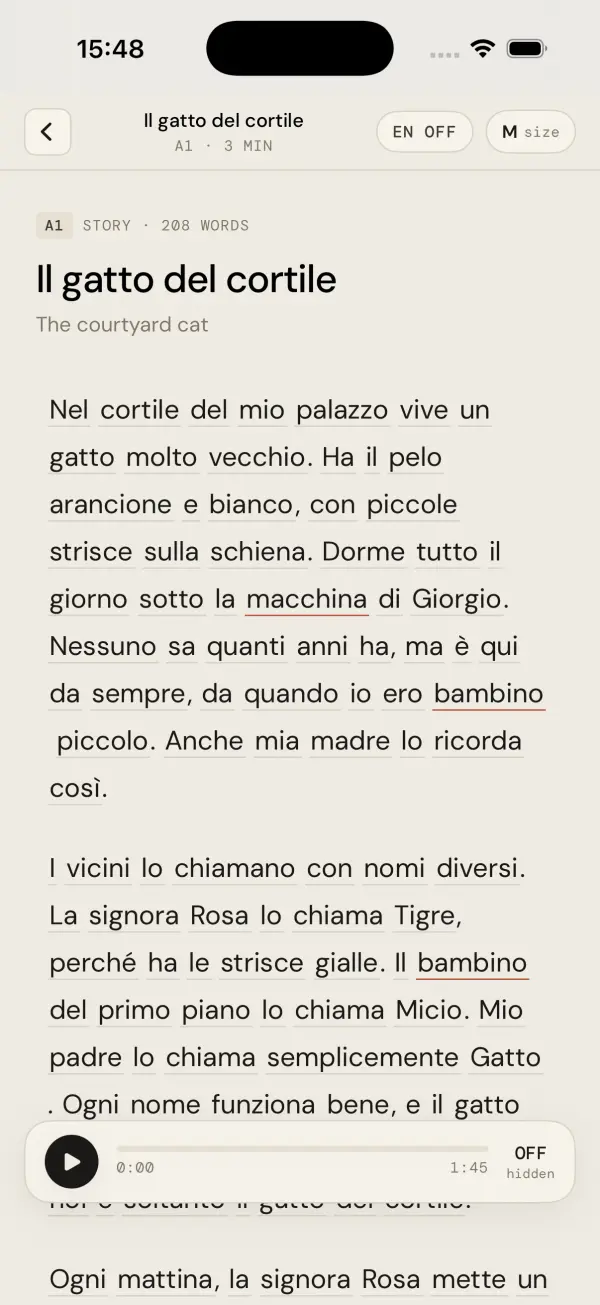
Expect present-tense sentences about simple things: a morning at the bar, a cat in a courtyard, a morning at the library. Around 150 to 250 words, mostly very common words, and a lot of repetition on purpose. If you are not sure where to start, start here.
 A1 · Story · 3 minLa colazione al barBreakfast at the barRead free →
 A1 · Story · 3 minIl gatto del cortileThe courtyard catRead free →
 A1 · Story · 3 minUna mattina in bibliotecaA morning at the libraryRead free →
A2: everyday life
Stories get a little longer and start to use the past, plans and descriptions. Expect weekends away, recipes and day trips, with more variety in the vocabulary. You will meet the passato prossimo (ho mangiato, siamo andati) here, so keep the English handy.
 A2 · Story · 4 minUn weekend a FirenzeA weekend in FlorenceRead free →
 A2 · Story · 4 minLa ricetta della pasta al pomodoroThe recipe for pasta with tomato sauceRead free →
 A2 · Story · 4 minUna gita sul Lago di GardaA day trip on Lake GardaRead free →
B1: culture and ideas
At B1 the stories become short texts about Italy itself: painters, film, food traditions. They are longer and use more tenses, so the topics matter more than the plot. Pick something you would want to read in English too, and the unknown words become easier to forgive.
 B1 · Story · 5 minCaravaggio e la luce che tagliaCaravaggio and the cutting lightRead free →
 B1 · Story · 5 minIl cinema neorealistaNeorealist cinemaRead free →
 B1 · Story · 5 minBologna la grassaBologna the fatRead free →
B2 and C1: close to real Italian
From B2 up, the stories are real essays on coffee culture, fashion and theatre, written the way an Italian would write them. They are a bridge to novels and the news. If you have reached this level, our list of books is the natural next step.
 B2 · Story · 4 minLa cultura del caffè espressoThe culture of espresso coffeeRead free →
 B2 · Story · 5 minMilano, capitale della modaMilan, capital of fashionRead free →
 C1 · Story · 7 minLa commedia dell'arteThe commedia dell'arteRead free →
How much should you read?
Ten to fifteen minutes a day is enough. One story, read with the routine above, is a good daily session. After a month, you will have read around twenty stories, met the most common few hundred words dozens of times each, and probably noticed that you have stopped looking at the English so often.
If you are wondering how long the whole journey takes, how long it takes to learn Italian gives honest numbers. And reading is only half the work: podcasts for beginners are the natural partner for stories, since you can hear the same sort of Italian you've been reading.
Other good sources of easy Italian reading
Verso is not the only place, and you will get further with more than one. Our guide to the best books to learn Italian goes into detail, but in short:
- Graded readers. Short books written for learners at a set level, such as the Italiano facile series from Alma Edizioni (A1 to B2, with free audio) and Olly Richards's Short Stories in Italian for Beginners. They are the printed version of what you've just been reading.
- Children's books. Gianni Rodari's Favole al telefono is short, funny and a good first real book once you reach B1.
- Books you already know. An Italian edition of a story you've read in English, such as Il piccolo principe, is much easier to follow because you know the plot.
Whatever you choose, the same rule applies: if you are looking up more than a word or two per page, go down a level.
Quick answers
Can I really learn Italian by reading stories?
Reading builds vocabulary and teaches you how sentences work, and it is one of the best things you can do on your own. On its own, it won't teach you to speak. Add listening, a little word review and, as early as you can, speaking aloud. The full plan is in the best way to learn Italian.
Should I look up every word?
No. Read for the gist first, then look up only the words that block you or that keep coming back. Looking up every word turns reading into decoding.
Are the stories really free?
Yes. Every story on this page opens on the web app at app.get-verso.org without an account.
Which level should I start at?
If you've never studied Italian, A1. If you're unsure, pick one story from A2 and do the first read without translations. If you got the outline, stay there. If you got almost nothing, go back to A1.
Reading in Verso
Verso is built around exactly this kind of reading. It has short bilingual stories and slow podcasts at your level from A1 to C1, and you tap any word for its translation. Words you save go into a spaced-repetition review, and Olo, our AI tutor, gets you talking about what you have read. There is a level test at the start, so you begin at the right story, and the free plan gives you ten minutes a day plus three tutor lessons a week. It runs on iPhone, and on Android, laptops and iPad in the web app.