Italian podcasts for beginners: how to listen, and which ones to try
The best podcasts to learn Italian, grouped by level from A1 to C1, with who each one suits and an honest downside. Plus how to listen so you really improve: transcripts, re-listening and shadowing.
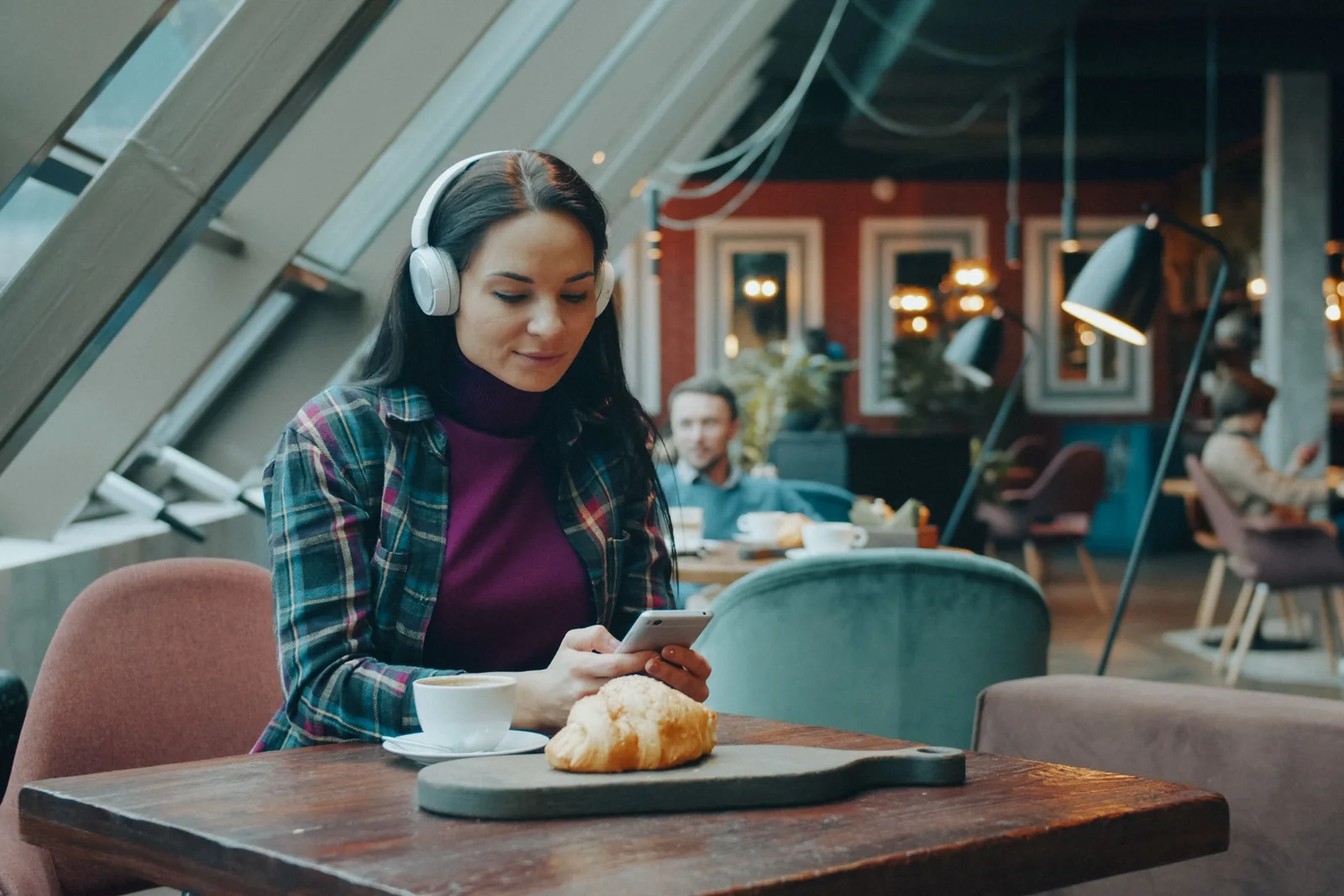
Short answer: as a complete beginner, start with a podcast made for learners, where a teacher explains in English and the Italian is slow and short. Coffee Break Italian is the classic choice. Once you can follow simple sentences, move to slow, all-Italian episodes with a transcript, and only later to podcasts made for Italians. What helps most is not the show you pick but how you listen: with the transcript, more than once, at your level.
A note first: we make Verso, which has its own slow podcasts, so read that entry with this in mind. We've tried to describe the others the way we'd want ours described. Check each show's own site for what is free and what isn't, because that changes.
Why podcasts are worth your time
Podcasts are the easiest way to add hours of Italian to a day that has no free hour. You can listen on a walk, on the bus or while you cook, and you hear how Italians really sound: the rhythm, the way words run together, the little fillers like allora and cioè.
The catch is that listening is the hardest skill for most beginners. Speech goes by faster than you can read, and there is no pause button on a conversation. A podcast aimed at your level fixes that, because the speaker is slow, the vocabulary is limited and you can replay anything.
A podcast is also not a course. It will not explain everything, and it will not make you speak. Treat it as the listening part of a routine, next to reading and some speaking. For the whole picture, see the best way to learn Italian.
How to listen so it actually helps
1. Pick the right level
If you understand almost nothing, you are not learning, you are just hearing noise. If you understand everything, you are not learning either. Aim for episodes where you catch most of the meaning and a few words are new. That is where the gaps fill in on their own. If you are not sure where you are, this guide to the levels and how long each takes will help.
2. Use a transcript
This is the single biggest upgrade. Listen once without it and see what you get. Then listen again while reading. You will find that many words you "didn't know" were words you knew in writing but couldn't catch in speech. Connecting the sound to the spelling is exactly the skill you are building.
3. Listen to the same episode several times
One new episode a day feels productive, but three listens of the same short episode do more. The first time you get the gist. The second time you catch details. By the third, you are understanding in real time, and that is a good feeling that keeps you going.
4. Shadow a few lines
Shadowing means repeating a line right after you hear it, copying the rhythm and the melody, not only the words. Pick one or two sentences you like, play them, and say them out loud five or six times. It takes two minutes and does a lot for your pronunciation. It is also a gentle first step toward speaking, which matters, because a podcast alone will not get you talking.
5. Save a few words, not all of them
Do not stop every ten seconds to look up a word. Listen first, then pick three to five words that came up more than once or that you actually want to use, and put them into a review deck. Words you meet in a story stay in your head far better than words from a list.
6. Keep it short and regular
Ten to fifteen minutes a day beats an hour on Saturday. A good routine is one short episode: listen, read the transcript, listen again, shadow two lines. That is it.
At a glance
| Podcast | Level | Language of the host | Best for |
|---|---|---|---|
| Coffee Break Italian | A1 and up | English and Italian | Starting from zero with a teacher |
| ItalianPod101 | A1 to B2 and up | English and Italian | Short dialogues with notes |
| Verso slow podcasts | A1 to C1 | Italian, with English in the transcript | Reading along and tapping words for their translation |
| News in Slow Italian | Around A2 to B2 | Mostly Italian, spoken slowly | Current events at a gentler speed |
| Podcast Italiano | Around B1 and up | Italian | Natural speech, with transcripts |
| Italiano Automatico | Around B1 and up | Italian | Listening to a teacher talk about everyday topics |
| Morning (Il Post) | B2 and up | Italian | Real Italian news as Italians hear it |
The levels are our own rough estimates, not official ratings. Try an episode before you commit.
Beginner podcasts (A1 to A2)
Coffee Break Italian
Suits: complete beginners who want to be taught, not just to listen.
Format: a teacher and a learner talk in English and slowly build up Italian phrases, lesson by lesson, from the very basics. It works like a short course in your ear. coffeebreaklanguages.com
Downside: a lot of it is in English, so you hear less Italian per minute than you would think. Some of the extra material, such as lesson notes, sits behind a paid plan, so check what the free episodes include.
ItalianPod101
Suits: learners who like short, structured lessons with a clear next step.
Format: short audio lessons built around a dialogue, with hosts explaining vocabulary and grammar in English. Lessons are arranged by level, from absolute beginner upward. italianpod101.com
Downside: it is a commercial platform, so the free lessons are a taste and the site pushes you toward a subscription. Some listeners find the dialogues a little stiff compared with real speech.
Verso slow podcasts
Suits: beginners who want every episode at their own level, and anyone who wants to read along and look things up while they listen.
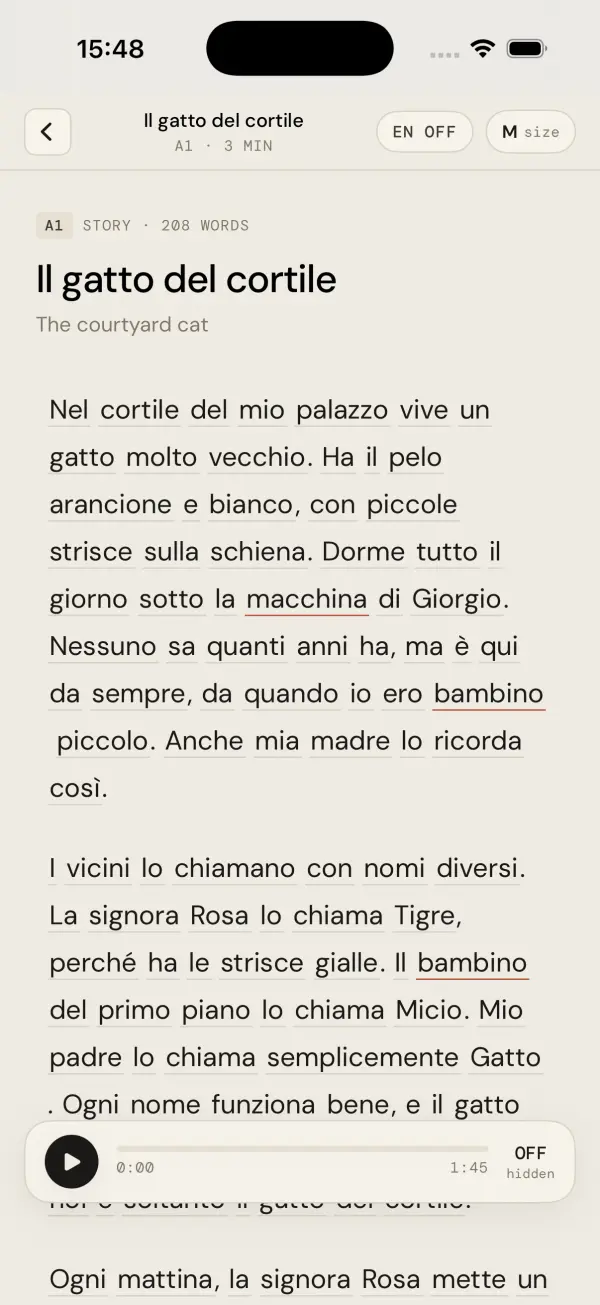
Format: short episodes on everyday topics and Italian life, written for each level from A1 to C1 and read slowly. Each one has a line-by-line transcript, and you can tap any word for its translation. Free to start, and you can play podcasts on the web without an account.
Downside: it is a young app with a much smaller library than the big names, the voices are AI voices rather than recordings of people, and the episodes are short, so they are a daily practice, not a full course.
Here are a few free ones, from A1 up:
 A1 · Podcast · 3 minLa colazione al barBreakfast at the caféListen free →
 A1 · Podcast · 3 minAl ristoranteAt the restaurantListen free →
 A1 · Podcast · 3 minLa cena della domenicaSunday dinnerListen free →
 A2 · Podcast · 5 minLa pizza di NapoliThe pizza of NaplesListen free →
 A2 · Podcast · 5 minIl caffè degli italianiThe Italian coffeeListen free →
Intermediate podcasts (A2 to B2)
News in Slow Italian
Suits: learners who can follow simple sentences and want to hear real topics.
Format: news and current affairs read at a slower pace, with explanations of the language along the way. It is made for learners at different levels, so check which one you are opening. newsinslowitalian.com
Downside: most of the material is paid, with only some free samples. News vocabulary can also be heavy, and the topics date quickly.
Podcast Italiano
Suits: learners around B1 who want natural Italian from a speaker who is easy to understand.
Format: Davide Gemello speaks Italian about language, culture and everyday topics, clearly and without talking down to you. Transcripts are available for many episodes, which makes it a good bridge between learner material and the real thing. podcastitaliano.com
Downside: it is mostly in Italian, so it is hard before you have the basics. Pace and topic vary from episode to episode, so you will skip some.
Italiano Automatico
Suits: learners who want to practise following a teacher who talks about daily life.
Format: Italian spoken by a teacher about everyday subjects and common ways of speaking, aimed at people learning the language.
Downside: it is not for absolute beginners, and it is mostly listening: it will not teach you grammar step by step.
Advanced podcasts (B2 to C1)
Morning, by Il Post
Suits: upper-intermediate learners who want to understand Italian news without any help.
Format: a short news podcast from the Italian news site Il Post, made for Italians, so it runs at natural speed and assumes you know what is going on in Italy.
Downside: it is not made for learners. There is no slowing down and no translation, and political and local references can lose you even when the language is clear. Come back to it at B2.
Verso, from B1 to C1
If you want a middle step between learner podcasts and Italian news, the slow podcasts from B1 to C1 cover history, literature and Italian life at a slower pace, with the transcript to catch what you miss. Here is one from each level:
 B1 · Podcast · 5 minL'aperitivo all'italianaThe Italian aperitivoListen free →
 B2 · Podcast · 8 minIl Rinascimento italianoThe Italian RenaissanceListen free →
 C1 · Podcast · 8 minDante e la nascita dell'italianoDante and the birth of ItalianListen free →
Going further: podcasts for Italians
At some point you will want to listen to what Italians listen to. Two tips: start with something you already care about, such as football, cooking or a hobby, because you will know the vocabulary. And turn on subtitles or a transcript if there is one. Do not expect to follow everything. At C1 you will still miss things, and that is normal.
What podcasts will not do
Podcasts build your ear and your vocabulary. They will not make you speak, and they will not show you how words look on the page unless there is a transcript. To keep progressing, mix them with:
- Reading at your level. Try easy Italian short stories for beginners, which pair well with listening.
- Review. Five minutes a day with a spaced-repetition deck.
- Speaking. A tutor, a language partner or an AI tutor, once a week at least.
If you are comparing tools, the best apps to learn Italian covers the options in more detail.
Common questions
Can I learn Italian just by listening to podcasts?
You can get a long way with listening, but not all the way. You will understand more, but you will not speak or write well without practising those skills. Use podcasts as one part of the routine.
I understand nothing. Should I keep going?
Move down a level. If a podcast feels like noise, it is too hard right now, and that is not your fault. Try a slow episode with a transcript, or a teacher-led show in English. Come back to the harder ones in a few months.
Should I slow the playback speed down?
You can, a little, and it helps with natural podcasts. But do not rely on it. Slow, clear speech made for your level is better practice than slowed-down fast speech, which sounds odd. Go back to normal speed as you improve.
How long before I understand a real Italian podcast?
It depends on how much you listen. Most learners need to reach about B1 to B2 before native podcasts feel manageable. See how long it takes to learn Italian for realistic numbers.
Start today
Pick one episode from this list, at a level where you catch most of it. Listen, read the transcript, listen again, and say two lines out loud. Tomorrow, do it again with the next one. That is the whole method. You can try a free Verso podcast right now on the web, no account needed. For the level test, review and Olo, the tutor, get the iPhone app, or use the Android / web app at app.get-verso.org on Android, laptops and iPad.